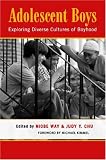
Perhaps men's studies should be called male studies. Leaders in the field encourage the study of all kinds of males. Books about men in their prime are most common; the number of books on older males is growing; this book is a nice contribution regarding adolescent males. To be honest, some chapters are just works where authors say, "I did research on Group X. Here's what I learned about the subgroup consisting of adolescent males." Still, this was a pretty good text.
The anthology is diverse in terms of race. In fact, at least one-third of the book covers African-American males. Perhaps this book should be classified under African-American studies. The book is diverse in terms of nation (the United States, China, Britain). Still, I thought more of a cross-national comparison in the chapters would have been useful. The book is diverse in terms of class. However, low-income males were labeled as such and upper-income males are left as unnamed, perhaps problematically "naturalized."
This book is definitely for psychology majors, more than any other group. Most chapters are quantitative and some are qualitative. For those who hate numbers-crunching, they can skip over methods and just read the intros and discussions. A close friend of mine was a psychology major who just HATES the field. When I asked him why, he said, "So many studies just prove the obvious. Fruits are good for your health. Getting enough sleep helps you during the day. Duh!" This book is FILLED with obvious hypothesis and conclusions. One chapter proved that boys from functional families perform better in school. Thanks for the numerical proof, but any thinking person already knows that. On the one hand, this book was so informative, but some of what is covered may insult the readers' intelligence.
Some chapters in the book did annoy me. For example, one chapter is titled "Boys in Men's Clothing." I thought it would be about male youth fashion, but it wasn't. It was about "hypervulnerability," a concept that was ill-defined an gobbledygookish. One chapter about black males, fathers, and suicidal thinking proved that father involvement may curb suicide. Again, duh! But secondly, the proof was for drug-free youth. Why wasn't substance abuse mentioned in the title's chapter then? There was some good stuff here. As always, Pedro Noguera's addition was informative, timely, and fantastic. I also liked the Hmong chapter and thought it was a good introduction to the text.
This is not a book for everyday concerned parents of male teens. It's for those in the psych field. Still, I give it thumbs up.
Buy it here now!
Tuesday, July 28, 2009
Adolescent Boys: Exploring Diverse Cultures of Boyhood Review
Posted by Alfred at 6:09 PM
Subscribe to:
Post Comments (Atom)
0 comments:
Post a Comment